
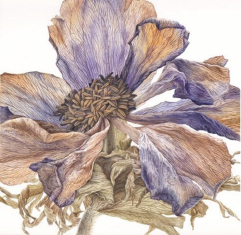
Celebrating Fading Flowers with Julia TRICKEY at West Buckland Village Hall
| Saturday, 30th October 2027 – 10am to 4pm
Workshop “The Art of Fading Flowers” In this workshop, we will explore the unique qualities of fading flowers, focusing on how to recreate their subtle, muted colours and delicate papery textures. You will learn techniques for capturing the translucency of ageing petals, when and how to use masking fluid effectively, and ways to add fine details that convey a sense of fragility and character. These topics will be explored through a series of short exercises, demonstrations and presentations, providing opportunities to develop both observation and painting skills. BIO Julia Trickey is a botanical artist and tutor with over 25 years of experience. Known for her larger-than-life paintings of fading flowers and seedheads, she has won four RHS Gold Medals and numerous other awards. Her work is held in the Shirley Sherwood Collection, the RHS Lindley Library, and private collections worldwide. Julia teaches internationally and online, and hosts the popular Botanical Art Talks MATERIALS LIST The following are just suggestions. If you already have artist-quality drawing and painting equipment, there is no need to buy anything especially. Drawing equipment • Pencils – HB, 2H as a minimum • Sharpener and Eraser. • A few sheets of tracing paper and/or cartridge paper (for initial drawings). • Tracedown transfer paper (optional – for transferring drawing onto watercolour paper). Painting equipment
WATERCOLOR PAINTSAny Artist quality paints in a range of colours will do, either half-pans or tubes (I prefer the latter).My primary colours are Winsor and Newton: Winsor Blue (green shade), Permanent Rose, Transparent Yellow. [Daniel Smith similar colours -Phthalo Blue (green shade), Quinacridone Red and Hansa Yellow medium.]Other colours I favour are:Daniel Smith – Quinacridone Gold, Sap Green, MayanDark Blue. Winsor and Newton – Winsor Red, Winsor Violet. GOOD QUALITY PAINT BRUSHESA larger brush (size 4,5 or 6) for washes and a fine brush (size 0 or 1) for veins and detail. A large brush with an excellent point can work for both eg Winsor and Newton Series 7 size 6.A small stiff brush, such as Billy Showell’s Eradicator, for lifting out.WATERCOLOUR PAPER Smooth Hot-Pressed paper is the usual choice of botanical artists, though Cold Pressed paper (also known as NOT) is good for practising certain techniques. I favour Arches or old stock (pre-2016) Fabriano Artistico Extra White – minimum weight 140lb (which I would stretch on a board to minimise buckling). Other good quality papers are available – it’s a personal choice!
OTHER EQUIPMENT • Water jar • Mixing palette or white china plate. • Cloth or kitchen paper. • A drawing board, if preferred. • Masking Fluid (optional). I recommend Pebeo Drawing Gum and a ruling pen or traditional dip pen. PLANT MATERIAL Though I can supply reference photographs nearer the time, I would suggest you collect some specimens such as fading petals and fall leaves, desiccated flowers, seedheads or other dried subjects e.g. daffodil bulbs. That said, do bear in mind that this is a one-day workshop, so you may not get as far with the more ambitious subject matter. Check my website for ideas of subjects that I favour – https://www.juliatrickey.co.uk/portfolio Booking can be done with the online booking form on the SWSBA website or contact Christine Rowson – SWSBA events organiser – sswsbaevents@gmail.com Jon Evans SWSBA Treasurer – swsbatreasurer@gmail.com The cost of this workshop is £40 for members and £50 for non-members payable to SWSBA treasurer via Bacs: Account number 02357720 Sort Code 309876
|